Panorama
Panorama from Aranybástya: Budapest's Most Beautiful View
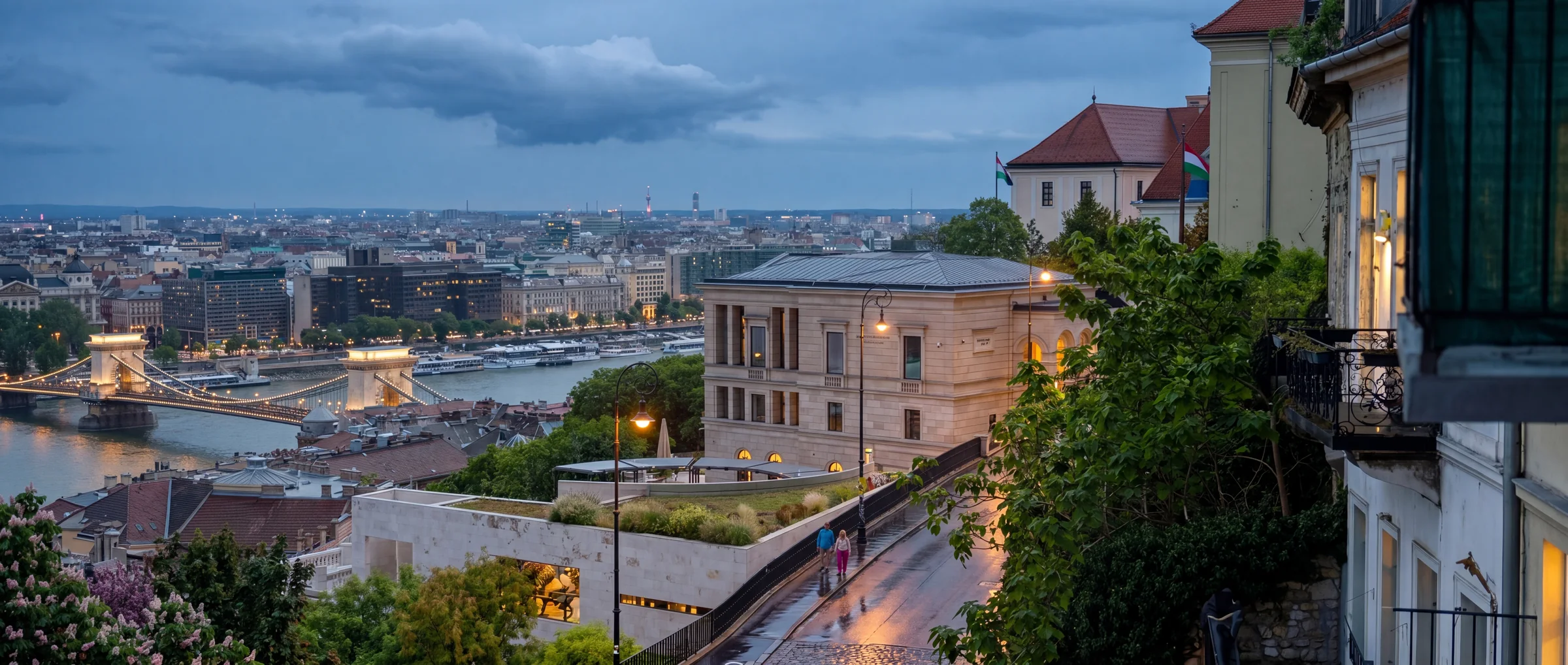
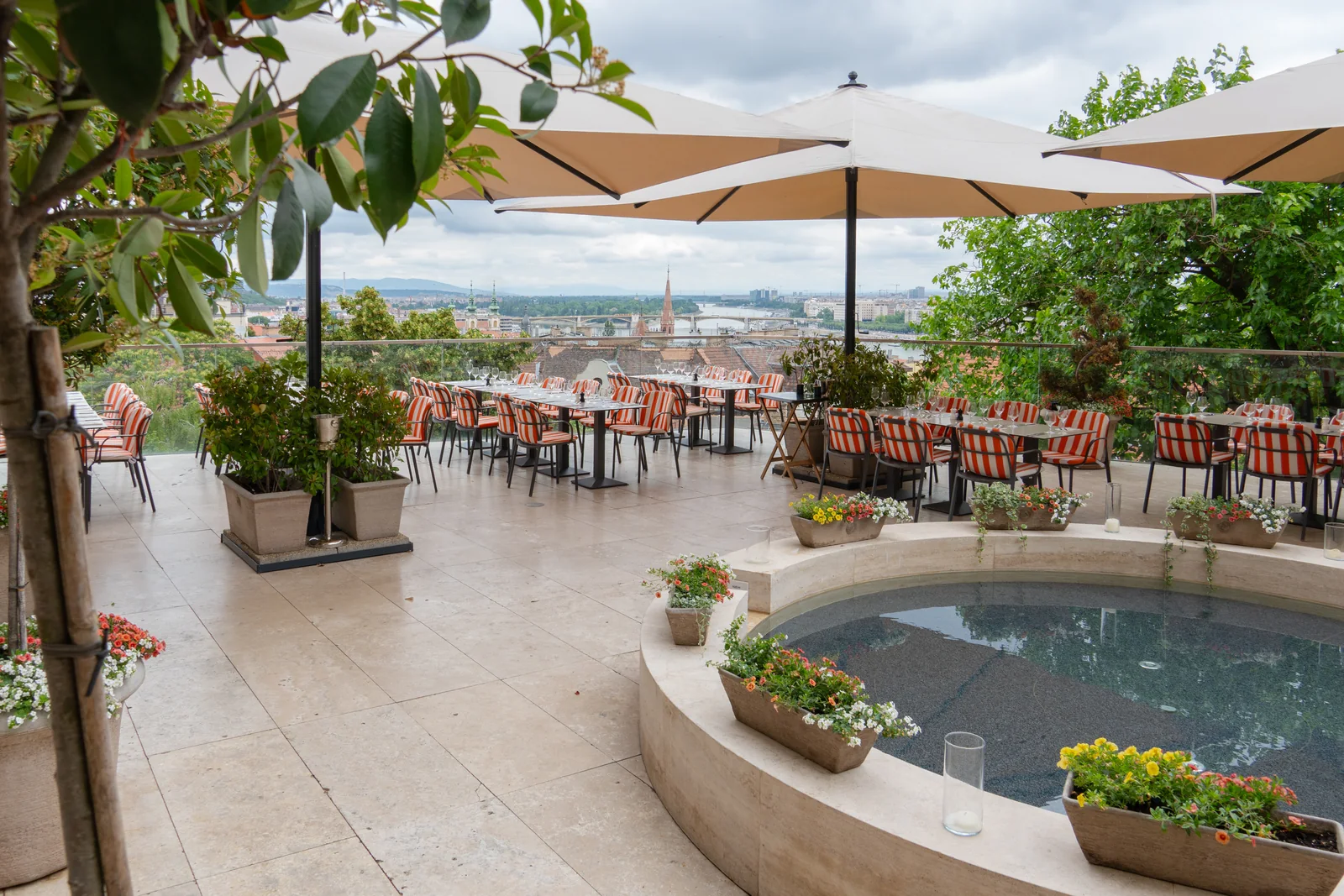
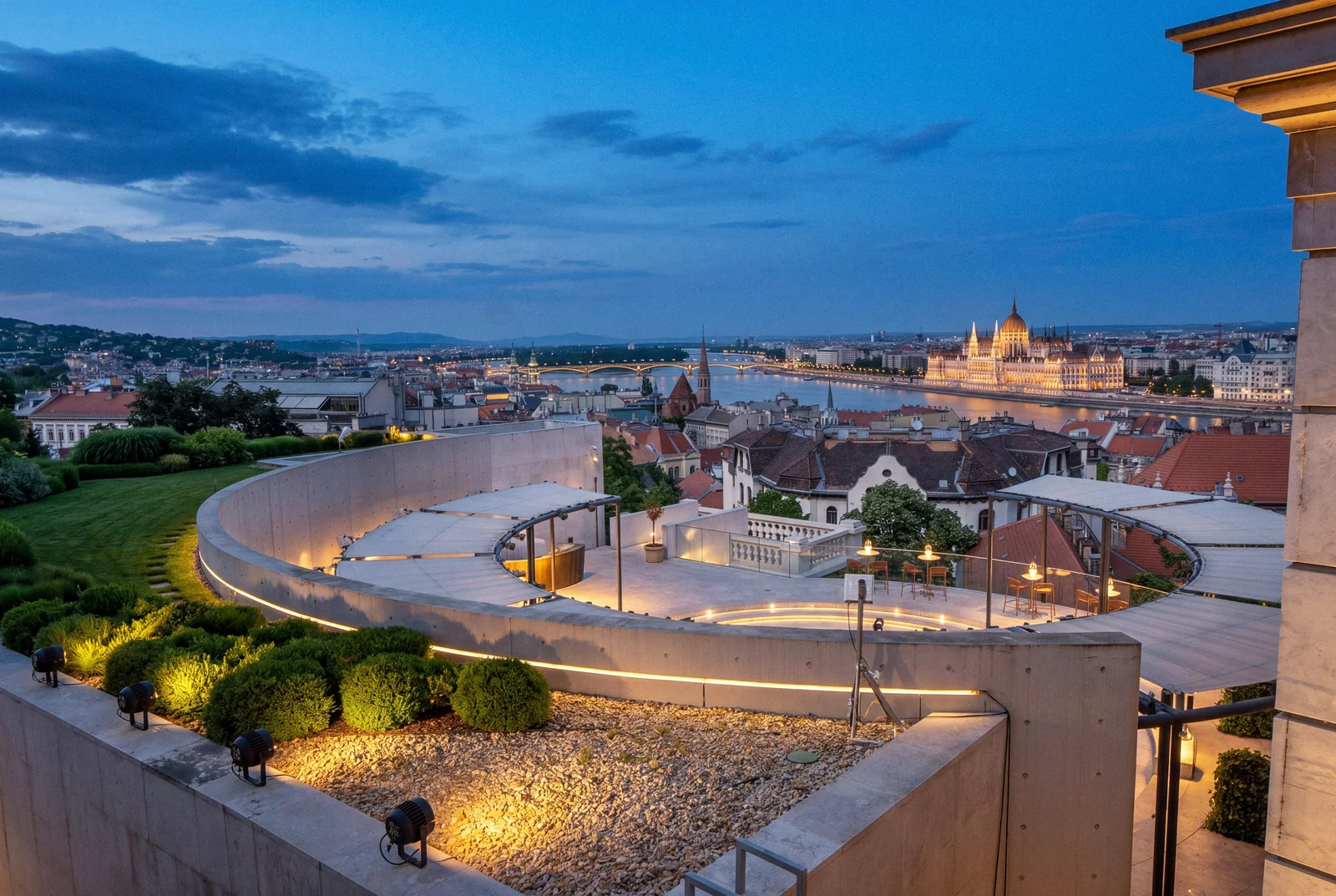
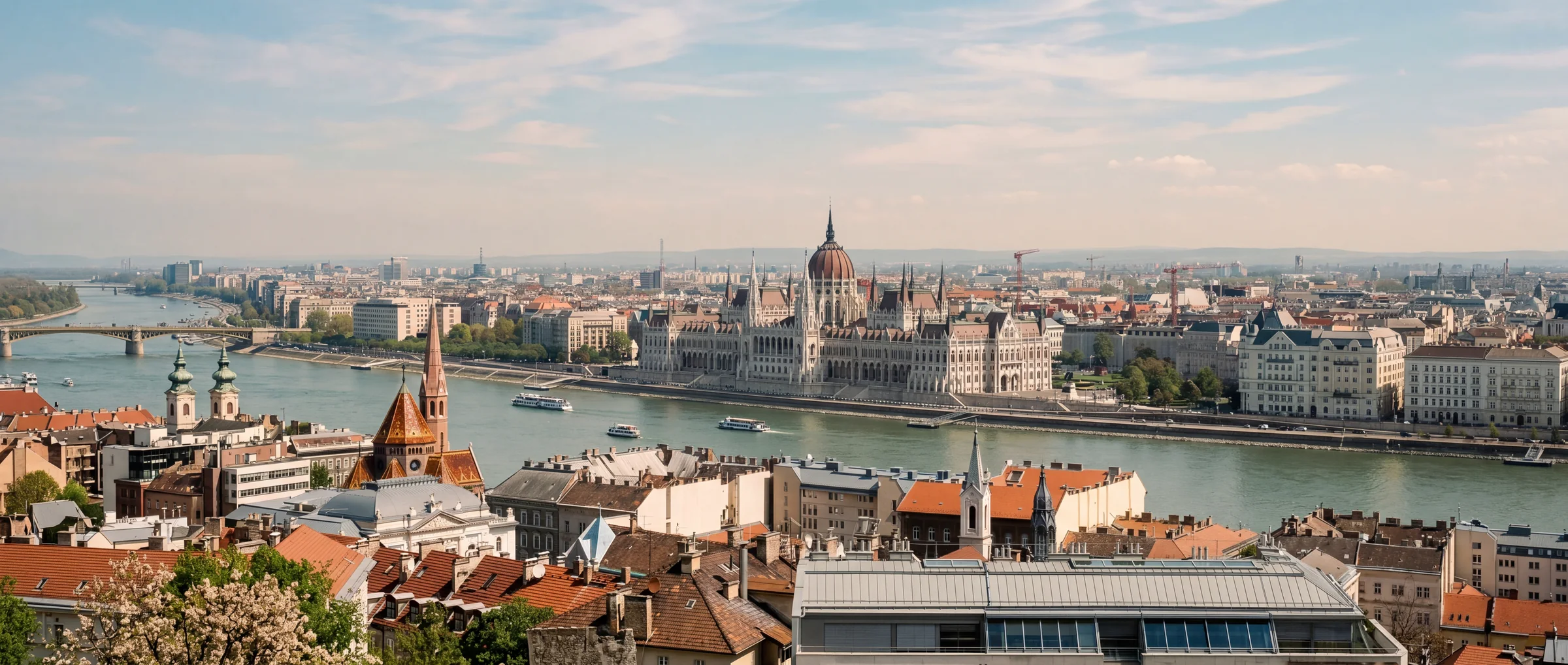
Across the Danube lie the Chain Bridge and St. Stephen’s Basilica. To the northeast stands the Parliament Building, and to the north, the Margaret Bridge comes into view. Above you is the historic silhouette of Castle Hill: the Fisherman’s Bastion and Matthias Church watch over the city. Lunch bathed in natural sunlight overlooking the capital, or dinner amid the illuminated lights of Budapest. That’s exactly why we say that Aranybástya is the restaurant with the city’s most beautiful view. Reserve a table and experience this unparalleled perspective for yourself.

From the terrace
What can you see from the terrace at Aranybástya ?
“Oh, my beloved Pest! You beautiful, vibrant, young city, the crown jewel of our country, spoken of with pride and love by every Hungarian—none of whom considers themselves truly happy until they have seen you. And whenever they catch sight of your rooftops from afar, their hearts swell with inspiring pride; and whatever happens within your walls—whether sorrow or joy—is the sorrow and joy of the entire country.”
Few cities can be said to tell the story of both the past and the present as spectacularly as Budapest does. The capital’s beauty is rooted in the balance of contrasts: the meeting of hilly, romantic Buda and flat, vibrant Pest, while the panorama comes to life in the reflection of the Danube. The river both separates and connects: history, culture, and people. In Budapest, the nearly two-thousand-year-old ruins of Aquincum meet the rich variety of 19th- and 20th-century architecture, so anyone who visits here takes part in a true journey through time.
The terrace at Aranybástya offers a postcard-perfect view, and every building here has a story to tell from the past centuries—the story of a metropolis coming into being. Anyone who stops here and takes in the view will feel that Budapest is not just a dot on the map, but a legendary city where history and culture intertwine.
The numbers are the same as those on the drawing next to the telescope on the terrace. We measured the direction and the distance as the crow flies from the villa.
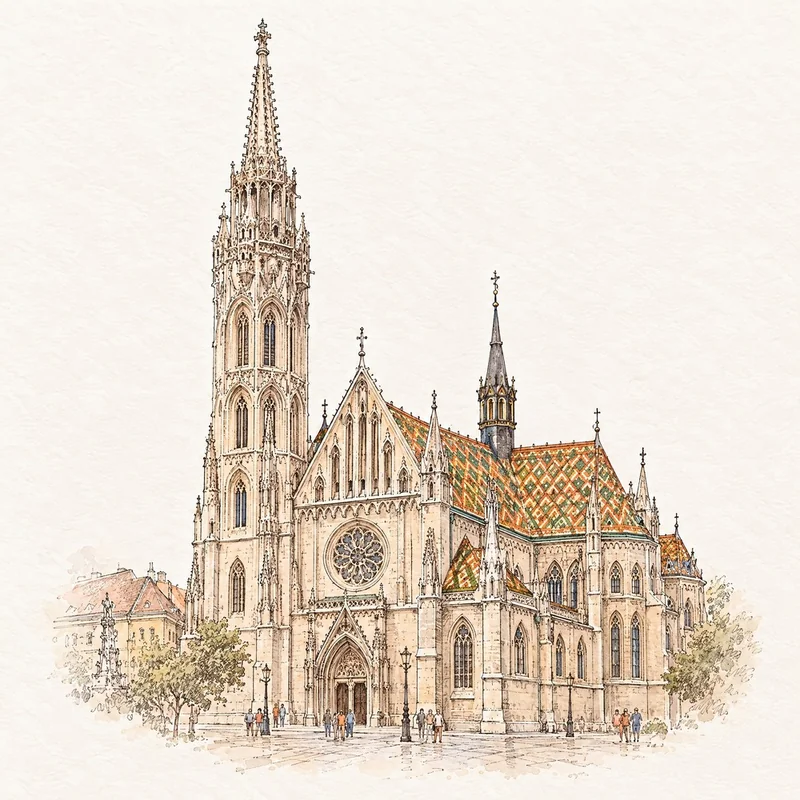
1 Northwest· 0.3 km
Mátyás Church
The Fishermen’s Bastion and Matthias Church are within walking distance of Aranybástya. According to church tradition, the church was founded by St. Stephen in 1015. King Matthias was married here; Franz Joseph I and his wife, Elisabeth, were crowned here; and later, the last Hungarian king, Charles IV, and his wife, Zita, were also crowned here.
By the end of the 19th century, hardly anything remained visible of the medieval church: multi-story houses were built right up against its two sides, and its main entrance was obscured by a porch. Beginning in 1873, it was rebuilt in a historicist, Neo-Gothic style under the direction of Frigyes Schulek, and it was rededicated in 1896, the year of the millennium. An integral part of its character is the roof covered with colorful Zsolnay ceramics.
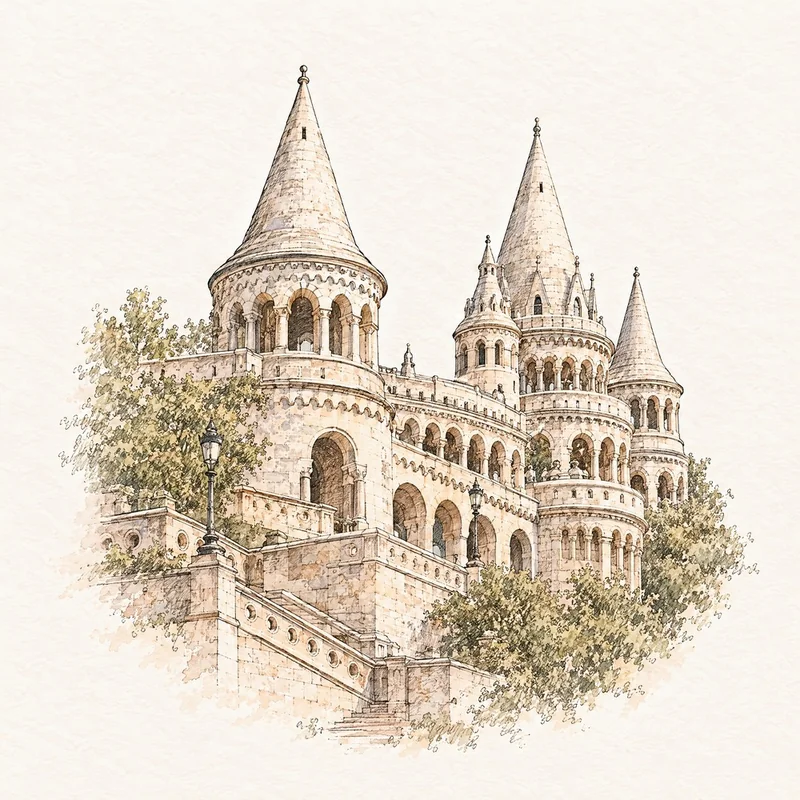
2 Northwest· 0.3 km
Fishermen's Bastion
The Fishermen’s Bastion, which surrounds St. Matthias Church, was designed by Frigyes Schulek and was built not as a defensive structure but as a lookout and promenade. According to tradition, it was named after the fishermen’s guild that defended this section of the castle wall. Its towers are connected by arcades reminiscent of the cloisters of medieval monasteries; the gargoyles, stone benches, and spires are particularly beautifully crafted. The restoration of damage sustained during World War II was led by Frigyes Schulek’s son, János Schulek, until his death.
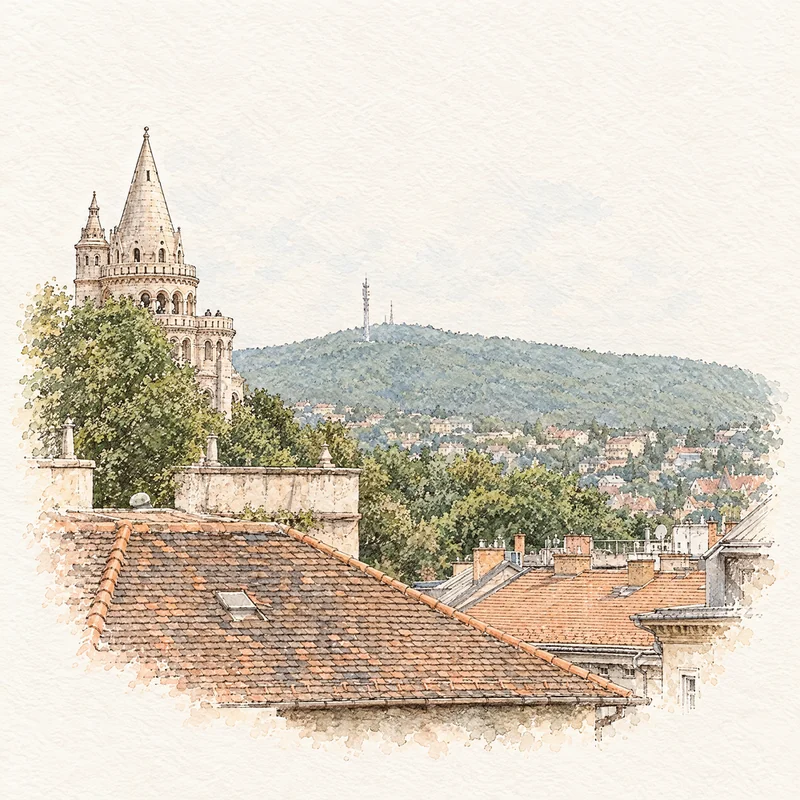
3 Northwest· 6.8 km
Buda Hills
From the terrace, behind the Fisherman’s Bastion, you can see the ridge of Hármashatár Hill (495 m) with its radio tower. The Buda Hills form one of the capital’s most important green belts. The highest point in Budapest is János Hill, at 527 meters. From the Erzsébet Lookout Tower at its summit, you can see almost the entire city; on clear days, the view extends as far as the Mátra Mountains, and on rare, exceptionally clear days, even as far as the Tatra Mountains.
There are more than 200 caves in the mountain range, which form a vast network of passages even beneath the city. Normafa, Hármashatár Hill, and Széchenyi Hill are not only popular destinations for hikers but also serve as one of the city’s “lungs,” as they are covered by extensive forests.
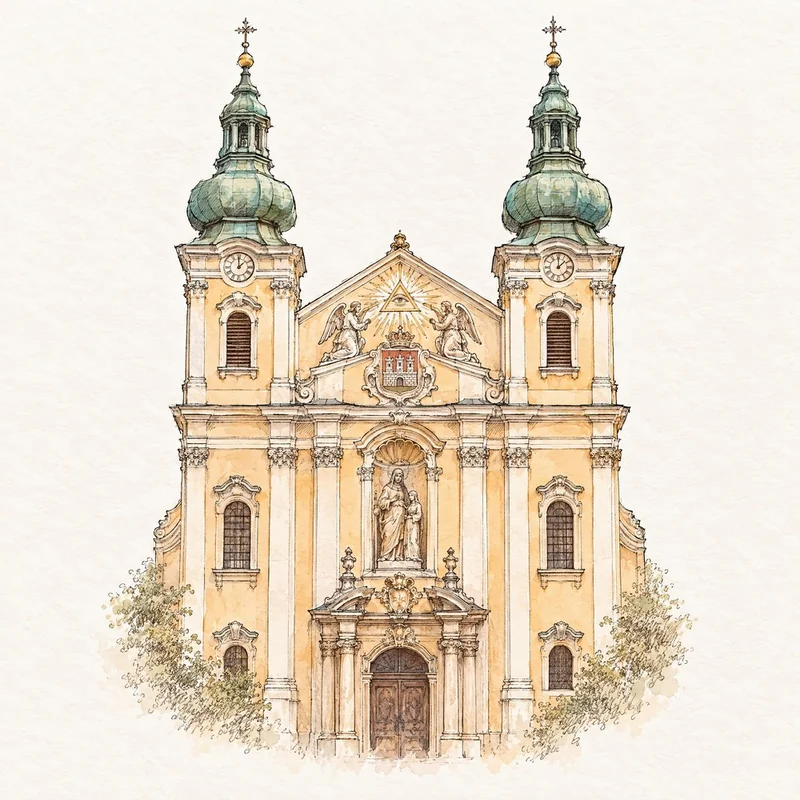
4North· 0.7 km
St. Anne's Church
St. Anne’s Church on Batthyány Square is one of the most beautiful churches on the Buda side. Its cornerstone was laid in 1740, and its sanctuary was consecrated in 1746; it was built under the direction of Kristóf Hamon and later Máté Nepauer. An earthquake in 1763 severely damaged the towers and vaulting of the nearly completed church; it was finally consecrated in 1805. At the time of its construction, Buda and Pest were still separate cities.
Between the two towers, the Eye of God is visible, flanked by adoring angels, with the coat of arms of Buda below it. The central sculpture on the façade is a monumental figure of Saint Anne in a niche.
5North· Behind the Bridge
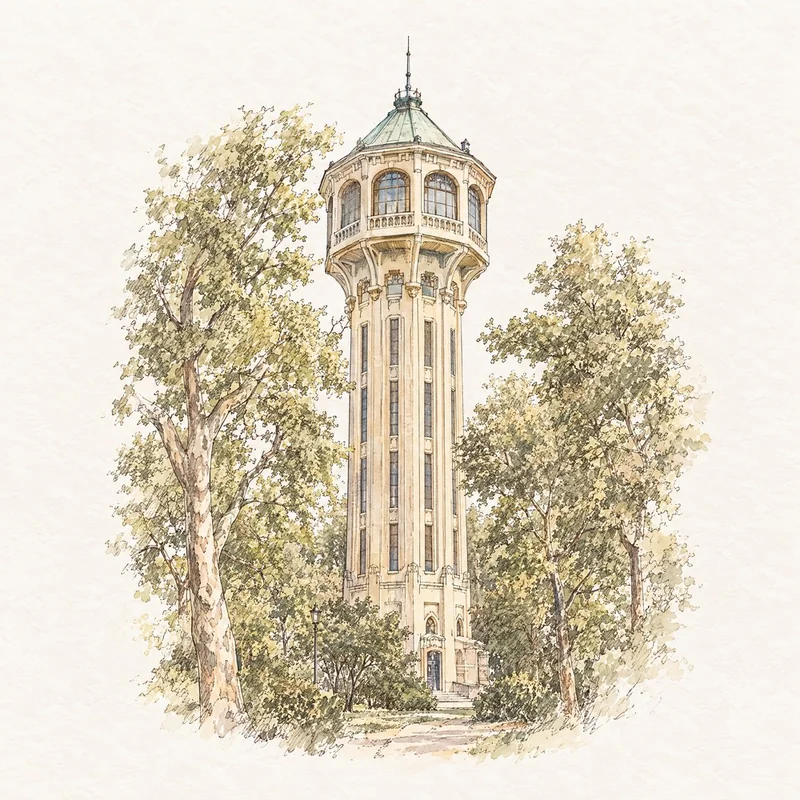
Margaret Island
Margaret Island lies on the Danube between Buda and Pest. With its ancient trees, walking paths, and thermal baths, it is a favorite destination for all visitors to Budapest. More than a hundred thermal springs well up from the depths in Budapest; the spring on the island, which gushes from a depth of 118.5 meters, was discovered in 1867.
Its history dates back to Roman times, and it was first mentioned in a document in 1225. Kings of the House of Árpád, as well as Dominican, Premonstratensian, Franciscan, and Johannite monks, lived here. Palatine József acquired the island in 1799, and its transformation into a park was overseen from 1808 onward by Károly Tost, the son of the head gardener at Schönbrunn. Although the Margaret Bridge was completed in 1876, the island could only be reached by boat until the turn of the century, when the bascule bridge opened.
Visible today are the ruins of the Dominican convent, where Saint Margaret of the House of Árpád—after whom the town is named—once lived, as well as a Romanesque-style replica of the medieval Premonstratensian Saint Michael Chapel, rebuilt in the 1930s. The water tower, built in 1911, is a landmark work of Hungarian reinforced concrete architecture. The Artists’ Promenade features statues of prominent figures in Hungarian culture, including Mihály Csokonai Vitéz, Bálint Balassi, Ferenc Liszt, Mór Jókai, János Arany, Zoltán Kodály, and Attila József.
6 North· 1.8 km
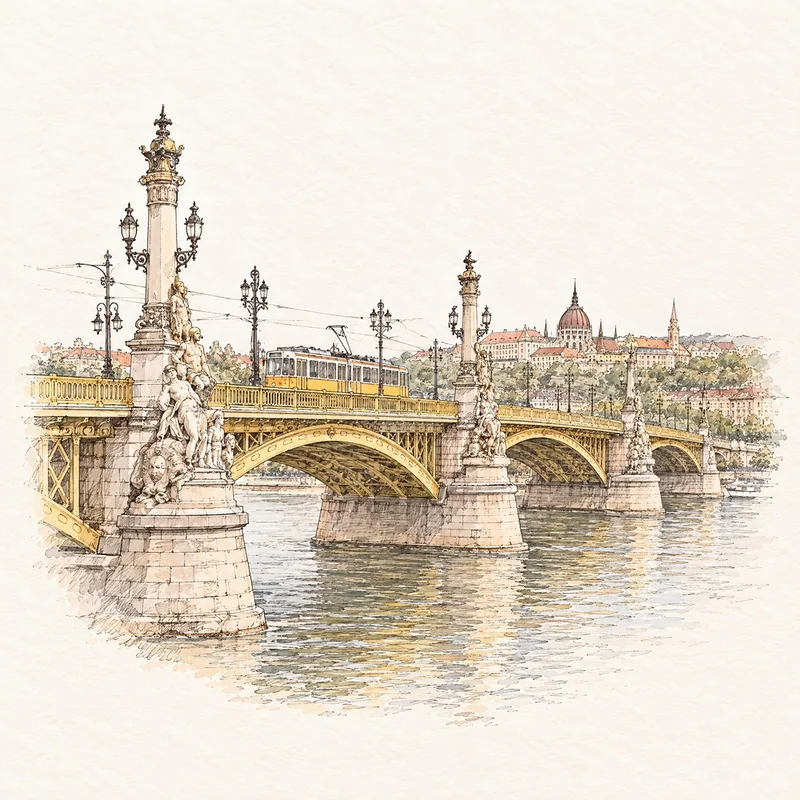
Margit Bridge
The Margaret Bridge is Budapest’s second permanent bridge: it connects Buda with the Grand Boulevard at the southern tip of Margaret Island. After the Chain Bridge was opened in 1849, another crossing was needed. A competition was announced in 1871, and 46 designs were submitted by 36 entrants; the French architect Ernest Gouin won the competition and also undertook the construction. This is the only bridge in Budapest that curves, thus connecting to Margaret Island. According to tradition, the writer Pál Gyulai suggested its name.
At first, a horse-drawn tram ran on it; later, an electric tram. It was blown up during World War II. Before the war, it was blue; afterward, it turned gray, and it acquired its yellow color in the late 1970s. From the center of the bridge, you can see the Parliament Building, Buda Castle, the Chain Bridge, the two riverbanks, and Margaret Island all at once.
7 North· 0.5 km
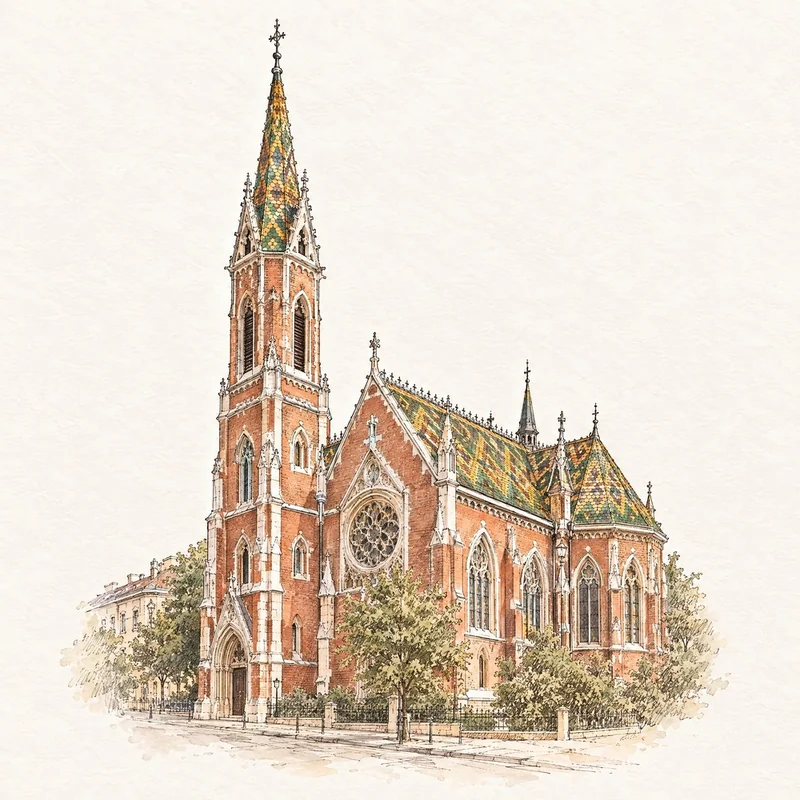
The Reformed Church on Dezső Szilágyi Square
The Neo-Gothic church was designed by Samu Pecz, to whom we owe several buildings in Budapest. When the design competition was announced in 1890, a key consideration was that the church be built on the banks of the Danube as a landmark defining the cityscape. Emperor Franz Joseph also gave his approval for the construction.
It has a pentagonal floor plan; its exterior walls are made of red brick, and its roof is covered with Zsolnay glazed tiles. The light streaming in through the pointed-arch windows and rose windows reaches every corner of the pentagonal space, making the interior bright and airy. The side aisles surrounding the nave are named after the four evangelists: moving clockwise, you come to the halls of Matthew, Mark, Luke, and John. It was consecrated on Palm Sunday in 1896 and was Buda’s first Reformed church to have its own building.
8 Northeast· 1.1 km
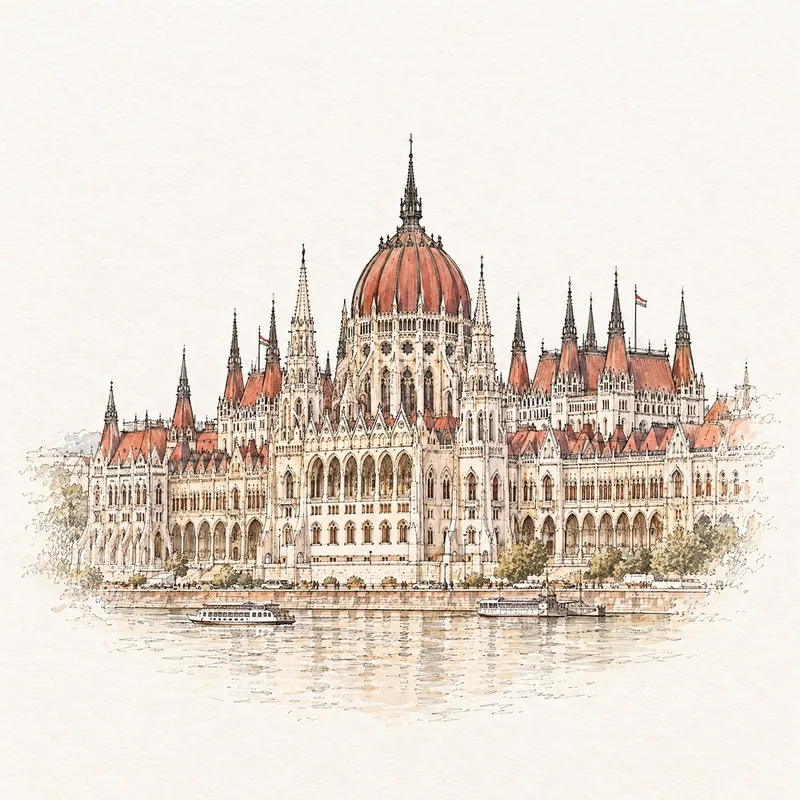
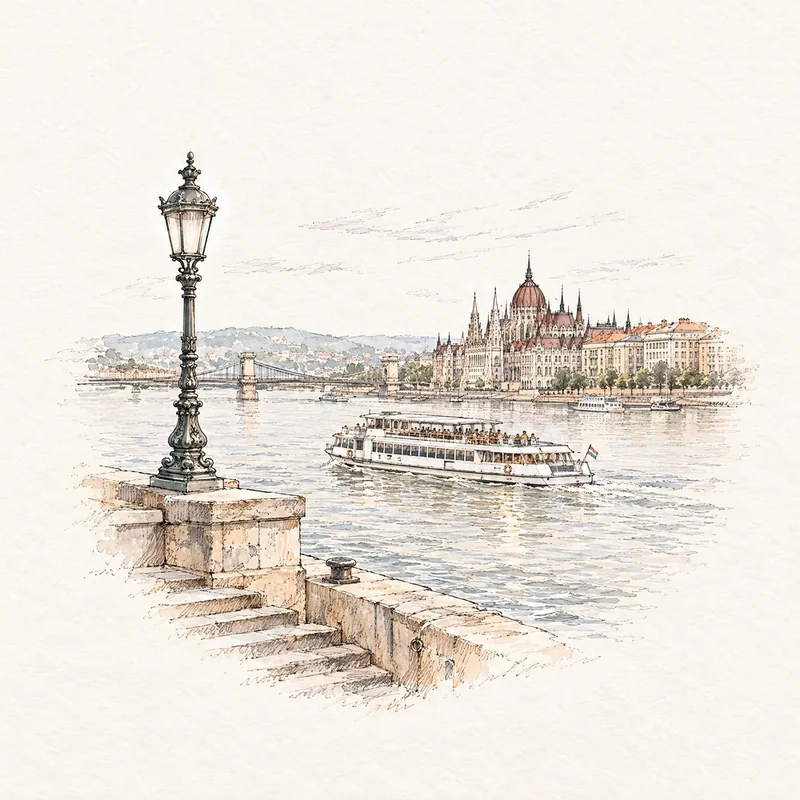
The Parliament Building
When the evening lights of the Parliament Building glisten on the water, the sight is as if history itself were bathed in radiance. The country’s most famous building is the jewel of the Pest embankment: this is where the National Assembly meets, and where the Holy Crown is kept.
In 1880, during the premiership of Kálmán Tisza, the National Assembly passed a law authorizing the construction of a permanent Parliament Building. As the millennium approached, there was a need for a building that would serve as a fitting symbol of Hungarian statehood. It was built between 1885 and 1902 according to the plans of Imre Steindl, who did not live to see its completion. The eclectic building features both Renaissance and Baroque elements, but its dominant style is Neo-Gothic. Almost all of the building materials came from domestic quarries and workshops, with the exception of the granite columns. Its ventilation and heating systems were among the most modern in Europe at the time of construction, and they are still in operation today.
It was built from approximately 40 million bricks and has a floor area of 18,000 square meters. There are 90 stone statues on its facade and another 152 inside. The wing running parallel to the Danube is 271 meters long, and the dome, including its spire, is 96 meters high.
9Opposite
The Danube
Budapest shines on both banks of the Danube, and few rivers offer such a panorama. The Danube winds its way through Europe, but it is perhaps here, in the heart of the Hungarian capital, that it reveals its most beautiful side. The city’s history also lies deep within its waters: the stones of old bridge piers, wartime wreckage, and sunken ships.
The Danube Riverbank and the Buda Castle District have been part of the UNESCO World Heritage List since 1987. On August 20, the fireworks display over the Danube can be seen from the terrace.
10 East· 0.7 km
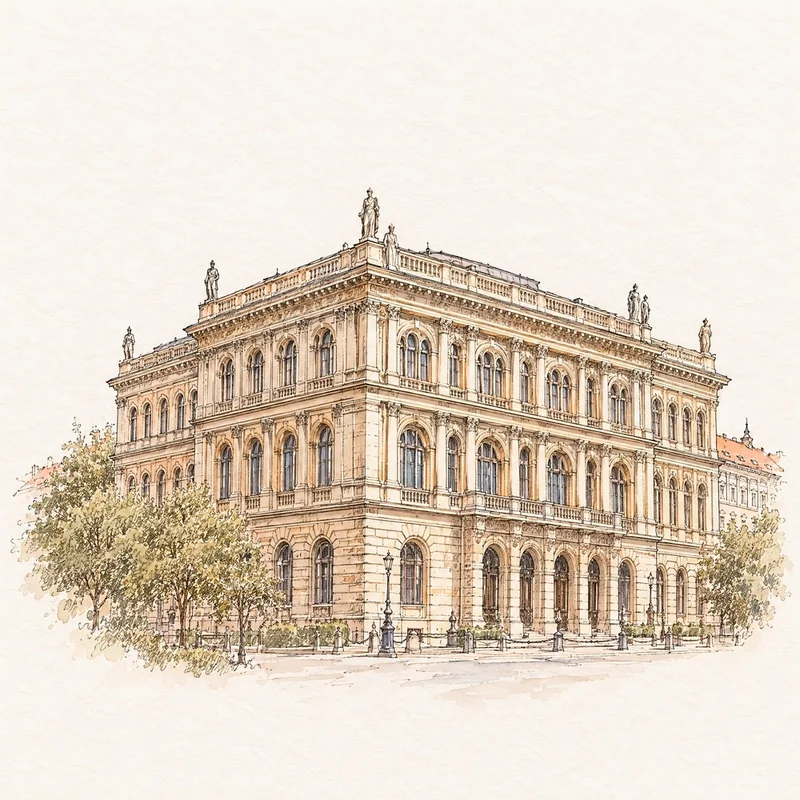
Hungarian Academy of Sciences
The Academy’s headquarters is located on Széchenyi Square, at the Pest end of the Chain Bridge. Like the bridge itself, the Academy was established thanks to a donation from István Széchenyi. The idea of a Hungarian scholarly society had already been proposed in the 18th century, and the predecessor of today’s Academy began operations in 1830.
The headquarters was built between 1862 and 1865 according to the plans of Berlin-based architect Friedrich August Stüler. The facade of this Neo-Renaissance palace is well-proportioned and beautifully articulated, and its interior decoration is the work of contemporary Hungarian artists. It was the first Neo-Renaissance public building in Hungary.
11 East· 1.3 km
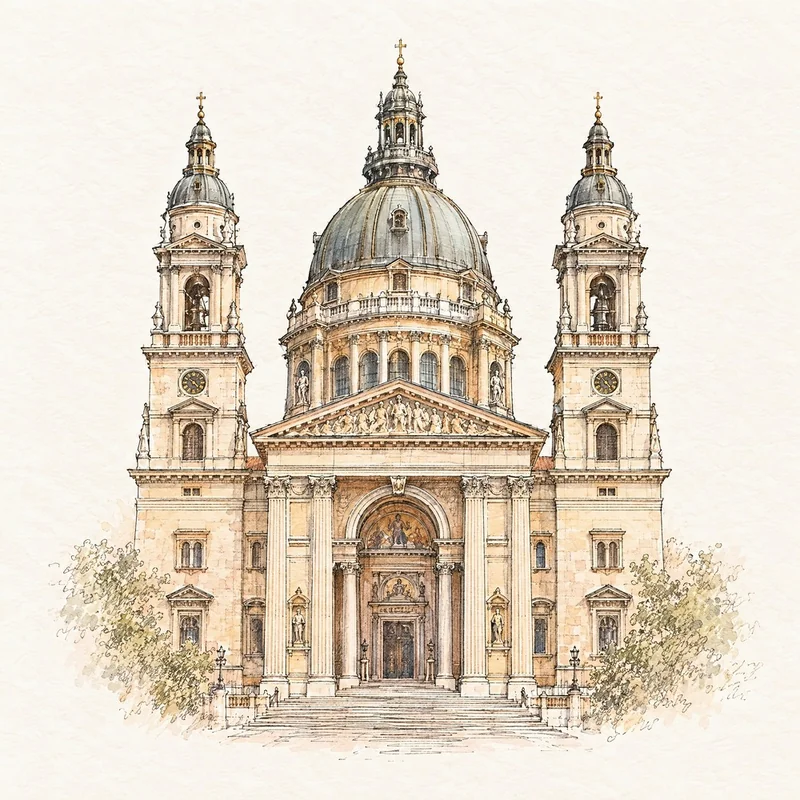
St. Stephen's Basilica
St. Stephen's Basilica is a Neo-Renaissance Roman Catholic co-cathedral towering over the heart of the city. It is named after St. Stephen, the founder of the Hungarian state, whose relic—the Holy Right Hand—is preserved here.
The construction was prompted by the great flood of 1838: several hundred people found refuge on a small elevation in what is now St. Stephen’s Square, and the survivors made votive donations to support the building of a church at the site of their rescue. In 1845, József Hild was commissioned to draw up the plans. Construction took more than half a century: in 1868, the dome collapsed, and work had to be restarted according to plans by Miklós Ybl. Ybl also designed the “ Lónyay-Hatvany ” villa, the home of Aranybástya . After his death, József Kauser completed the construction, and the church was consecrated in 1905. From the observation deck of the dome, one can see a complete panoramic view of Budapest.
12 East· 0.8 km
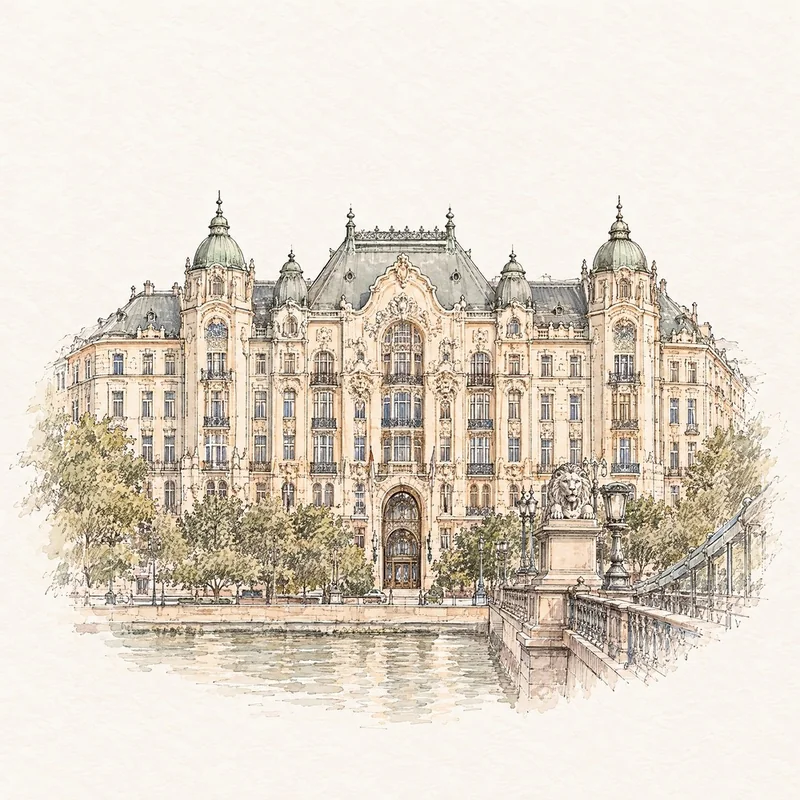
Gresham Palace
The Art Nouveau palace standing at the Pest end of the Chain Bridge was the Budapest headquarters of the London-based Gresham Life Insurance Company. Designed by Zsigmond Quittner and József Vágó, it was built in the early 20th century. The Gresham Café once operated on the ground floor; today it is a luxury hotel.
13 East· 0.5 km
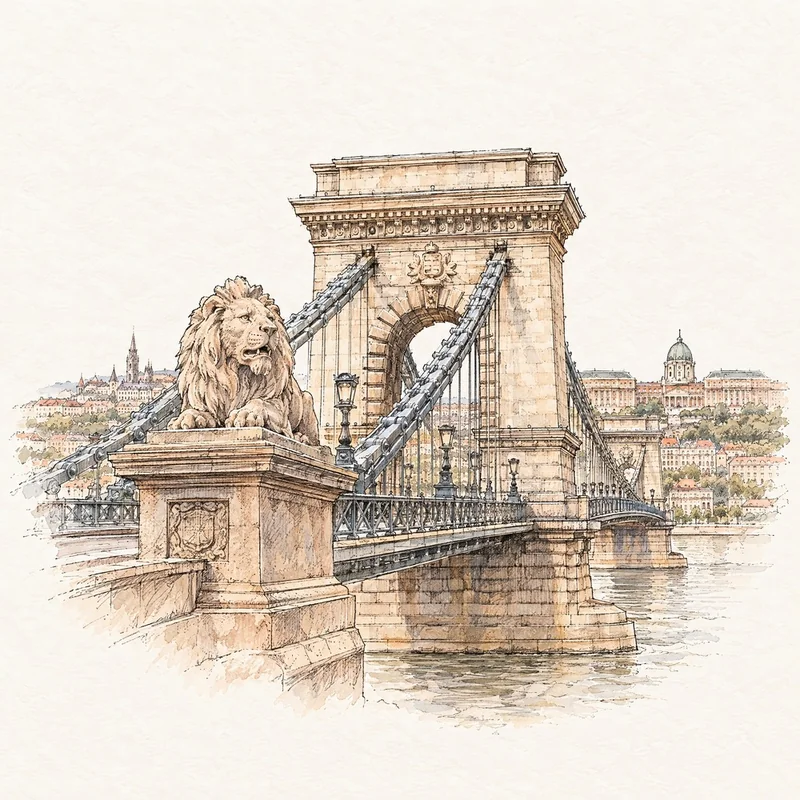
Chain Bridge
The Danube has been flowing beneath the Chain Bridge for more than a century and a half. It was the first permanent bridge connecting Buda and Pest, and it foreshadowed the city’s unification in 1873, which also incorporated Óbuda. It was built on the initiative of Count István Széchenyi; it was designed by the Englishman William Tierney Clark and constructed by his Scottish namesake, Ádám Clark. During construction, Széchenyi once fell into the Danube himself, but swam out unharmed.
The first pile was driven into the ground in the summer of 1840 at the Buda riverbank pier. The pile-driving work lasted two years, and at times as many as 800 people were working on it simultaneously. Palatine Joseph laid the cornerstone on August 24, 1842, during a ceremony attended by several thousand people: the 130-mazsa stone was lowered on a chain powered by a steam engine, at the command of chief engineer James Teasdale. The bridge was opened in November 1849, and initially, a toll had to be paid by anyone crossing it. It became a symbol of renewal during the Reform Era.
According to urban legend, the stone lions have no tongues. In fact, they do have tongues, but they’re hard to see from below. In January 1945, retreating German troops blew it up. The rebuilt bridge was opened on November 20, 1949—exactly one hundred years to the day after its initial opening. Following its most recent renovation, it reopened in its entirety in 2023.
In photos
This is the view from the patio
Questions
Frequently Asked Questions About the View
Yes. From the terrace, the Parliament Building is visible to the northeast, about 1.1 kilometers away as the crow flies, with its entire facade facing the Danube.
The Parliament Building, the Danube, the Chain Bridge, Gresham Palace, the headquarters of the Hungarian Academy of Sciences, St. Stephen’s Basilica, Margaret Bridge, Margaret Island, St. Anne’s Church, the Reformed Church on Dezső Szilágyi Square, the Fisherman’s Bastion, Matthias Church, and the Buda Hills.
In the Buda Castle District, at the “ Lónyay-Hatvany ” villa, located at 1 Csónak Street. Approximately 300 meters as the crow flies from the Fisherman’s Bastion.
Yes. The Panorama Terrace and the Private Terrace can be rented separately. Civil ceremonies can also be held on the Private Terrace, which offers a view of the Parliament Building and the Chain Bridge.